01
Level 1
Reactive
Equipment fails, maintenance responds. Cost and downtime are set by the failure, not by you.
Failure driven
 Asset Digital Intelligence
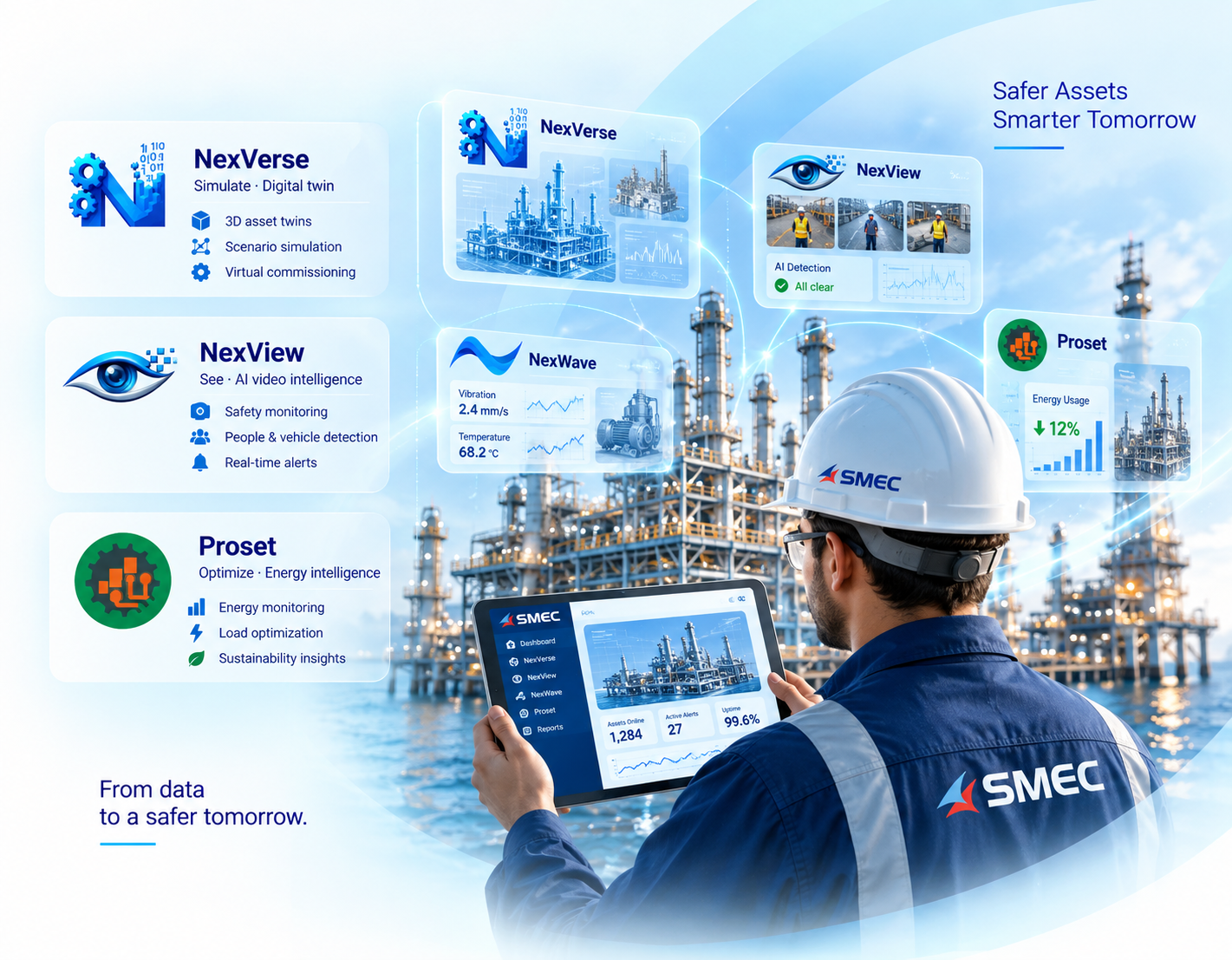
Turn the video, equipment, maintenance and engineering data your asset already generates into visibility your operations, maintenance, safety and engineering teams can actually act on.
AI video analytics · remote condition monitoring · predictive-maintenance software · digital twin technology — for Oil & Gas, offshore, marine, ports and industrial plants across the Middle East, India and global project locations.
Deployed across
SMEC Asset Digital Intelligence is an engineering-led digitalization framework that connects existing CCTV, PLC and SCADA, maintenance and engineering systems into four platforms — real-time data acquisition, AI video intelligence, asset management and CMMS, and digital twin and simulation — for Oil & Gas, marine, offshore and industrial facilities across India, the Middle East and global project locations.
The question is whether it is actionable. Most operating facilities have already invested in automation, instrumentation, industrial CCTV and maintenance systems, yet operational visibility still depends on people connecting the dots by hand.
Recording continuously, but important events still depend on someone watching a screen.
Generating thousands of signals, but condition information stays distributed across systems.
Years of service history recorded, but spotting patterns across assets remains difficult.
Drawings, documents and asset data, spread across multiple platforms and formats.
The result: an asset with substantial data, and limited contextual visibility. SMEC Asset Digital Intelligence is built to close that gap.
AI video analytics, industrial IoT condition monitoring, maintenance intelligence and digital twin technology — different assets have different digitalization priorities. Explore each layer below.

Real-time IoT, data acquisition and industrial connectivity
The data layer. NexWave acquires from field instruments, PLCs, SCADA systems and standalone sensors, handles the connectivity, and presents the result as real-time dashboards and centralised visibility. It is the platform behind our research, defence and drilling work, where sample rates and reliability leave no room for a generic IoT stack.
Also covers industrial IoT monitoring, condition trending and maintenance decision support across distributed assets.
Discuss a data acquisition requirement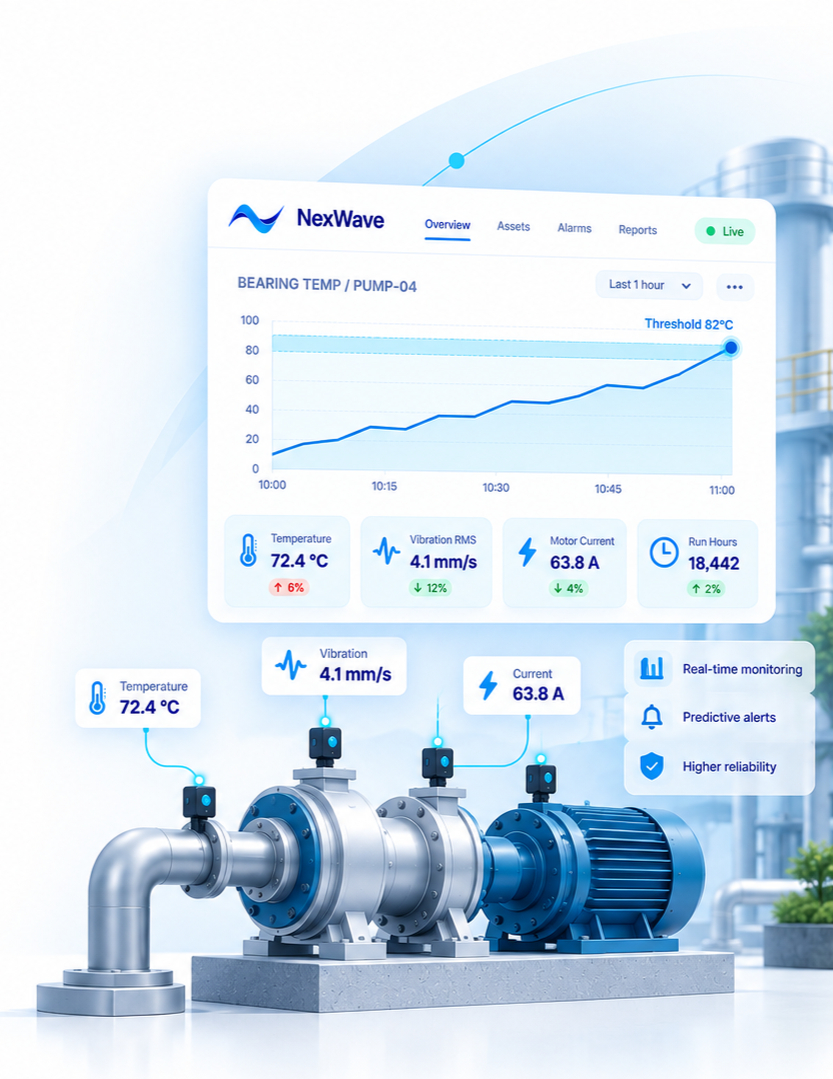

AI video intelligence and safety monitoring
The vision layer. NexView applies computer vision to the CCTV already installed on your site, turning passive recording into real-time detection. It identifies safety violations, people and vehicles, and restricted-area breaches, then alerts the team who can act, rather than filing footage nobody reviews.
Starting point: SMEC reviews the existing industrial CCTV environment, the required detection use cases and the network architecture, from single-site coverage to centralised video monitoring across multiple facilities.
Assess my existing CCTV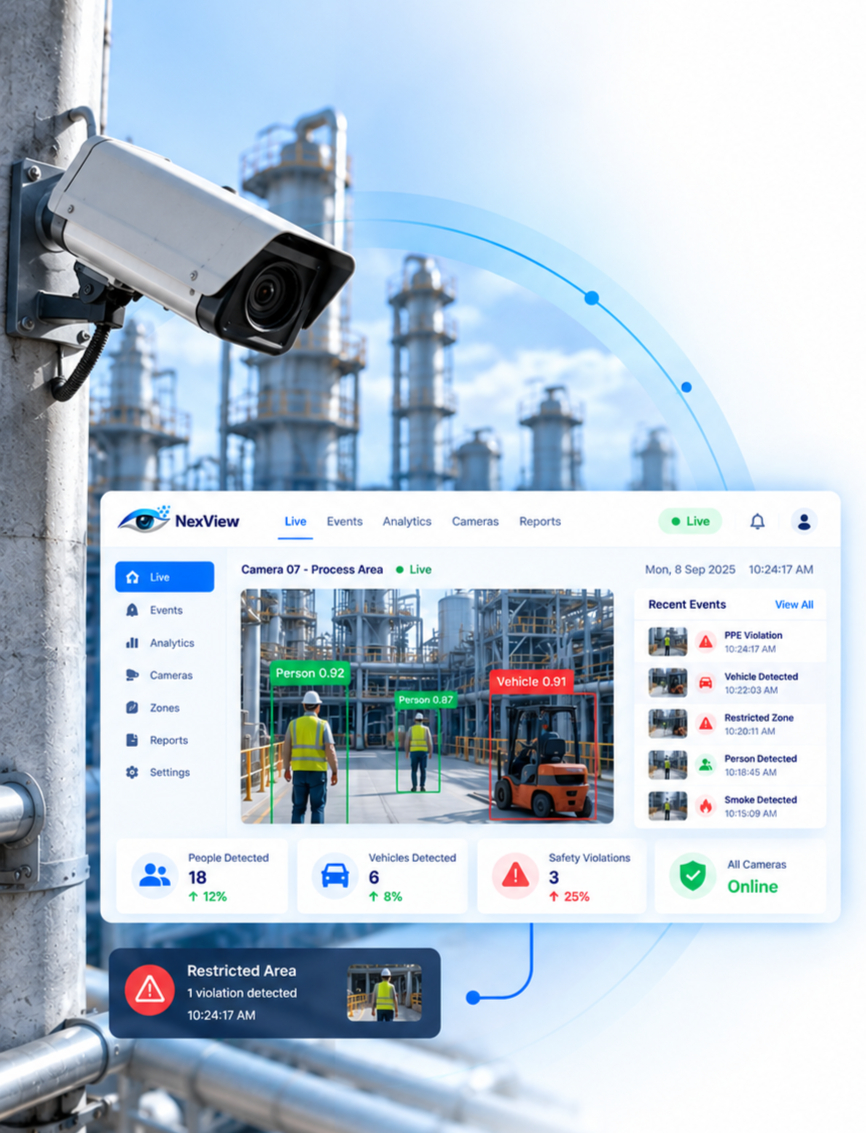

Operational monitoring, asset management and CMMS
The management layer, and the widest of the four. ProSet360 pulls data from multiple systems into a single supervisory interface, and carries a full CMMS underneath it: asset register, preventive maintenance scheduling, work orders, spare parts and complete maintenance history. One place to see what is running, what it needs, and what it has cost you.
The core questions: what assets exist, what condition are they in, what maintenance has been performed, what is pending, and which equipment repeatedly demands attention?
Review our maintenance workflow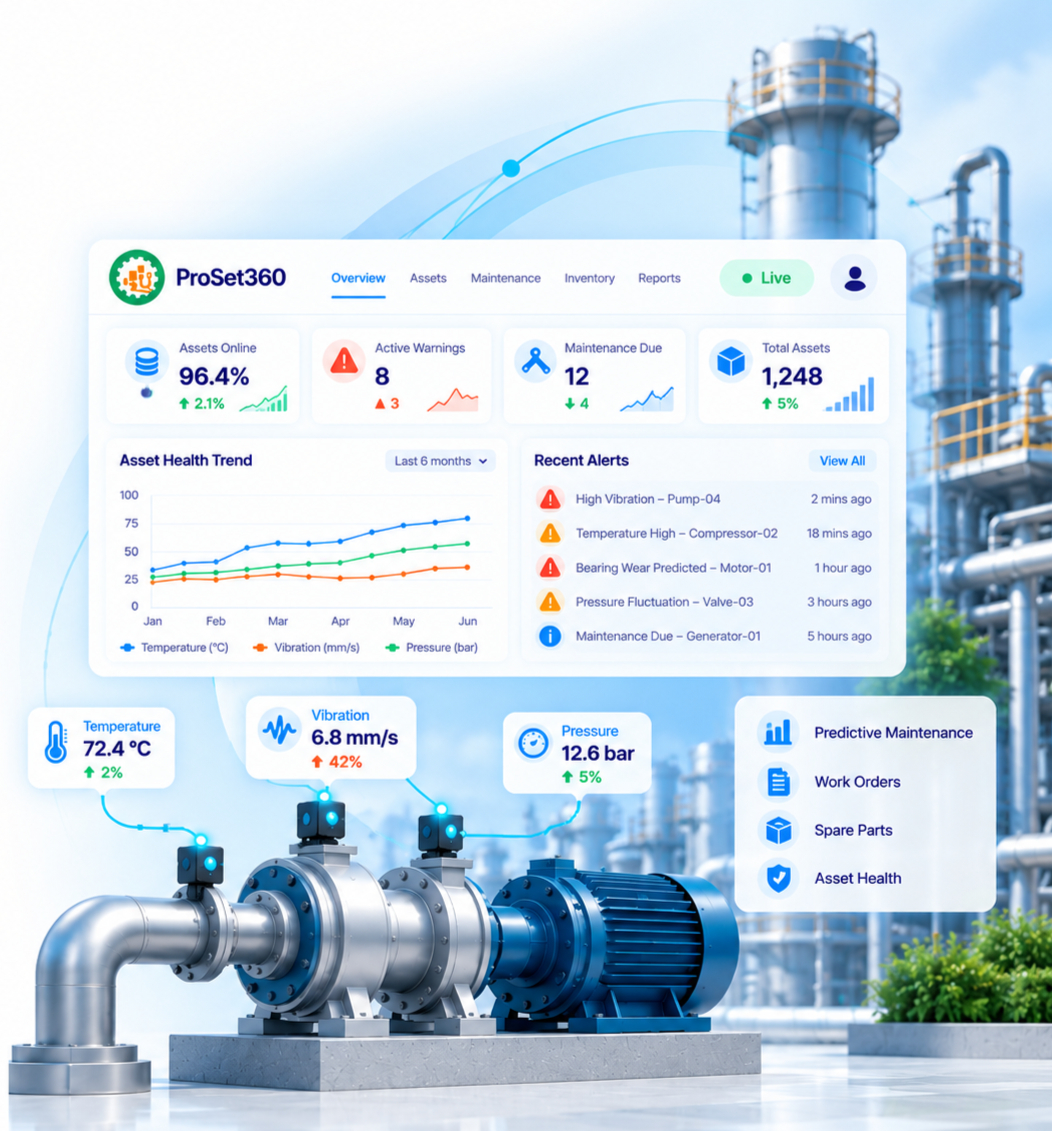

Digital twin, simulation and virtual engineering
The predictive layer. NexVerse builds a working digital replica of an asset, system or operation so its behaviour can be tested, validated and optimised virtually before anything is committed in the field. It is where a change gets proven, a failure mode gets explored, and a commissioning sequence gets rehearsed without risking the physical machine.
For complex physical assets where lifecycle information currently sits scattered across disconnected systems and formats.
Discuss a digital twin requirement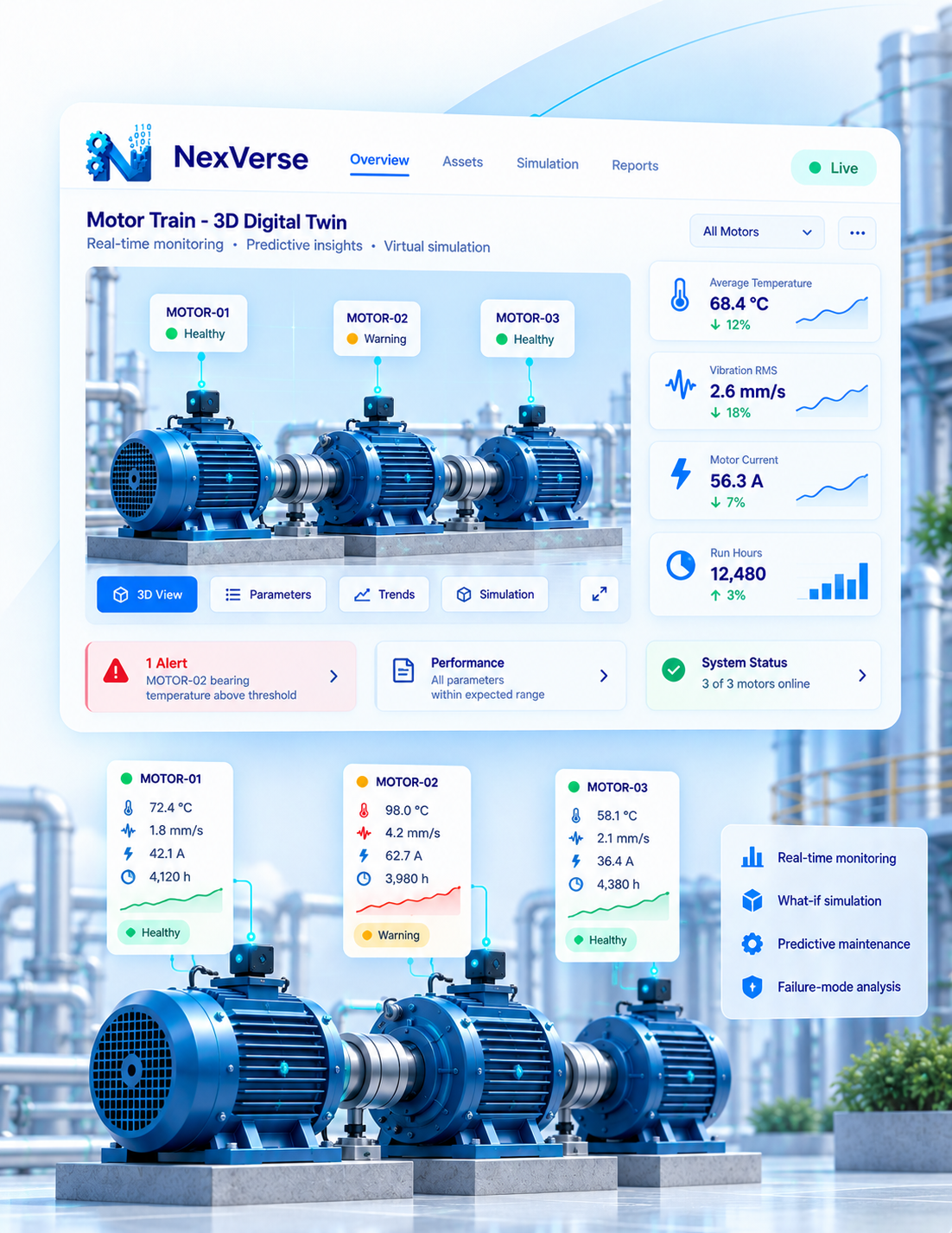
| Operational need | SMEC platform |
|---|---|
| Field data acquisition and real-time equipment visibility | NexWave |
| Video-based safety, security and operational events | NexView |
| Maintenance, asset register and lifecycle management | ProSet360 |
| Digital asset, simulation and engineering visualisation | NexVerse |
Technology trusted across energy, defence, manufacturing, infrastructure and industrial operations.













An operating facility already contains significant digital infrastructure. SMEC starts by evaluating what is already there, and only then proposes what is missing.
Select a sector to see the relevant platforms, asset classes and the closest work already delivered.
Upstream, midstream and downstream assets, combining some of the most complex automation, instrumentation and rotating equipment in industry.
Production facilities · Refineries · Petrochemical plants · Tank farms · Pipelines · Terminals · Wellheads · Compressor stations
Closest work: AI video intelligence for a downstream operator, a digital twin pilot for an upstream operator, and real-time drilling and well monitoring for a drilling services contractor.
Discuss an Oil & Gas projectA rig contains thousands of interacting mechanical, electrical, hydraulic, instrumentation and control components, on a link that is never guaranteed.
Drilling systems · Mud pumps · Drawworks · Top drives · Generators · Motors and drives · Utility systems
Closest work: real-time drilling system, rig and well monitoring delivered for a drilling services contractor.
Review an offshore assetMachinery, compartment and maintenance information brought together for the technical team, on board and ashore. This is our deepest reference area.
Naval vessels · Commercial vessels · Offshore support vessels · Tankers · Workboats · Fleet operators · Shipyards
Closest work: pump and motor digital twins, compartment management systems, yard temperature monitoring, kiosk display and surveillance systems, all delivered in naval defence.
Discuss a vessel or fleetLarge ports combine people, vehicles, heavy machinery, restricted areas, warehouses and critical infrastructure across a wide footprint.
Container terminals · Bulk terminals · Warehouses · Logistics facilities · Cranes and handling equipment
Closest work: naval yard monitoring and surveillance systems, and multi-site utility monitoring for a state power utility.
Assess a port or terminalUtility and heavy-industry environments where motor and pump fleets dominate the asset base and distribution is spread across many sites.
Power plants · Solar plants · Substations · Water supply networks · District cooling · Metals · Cement · Manufacturing
Closest work: data logging and operational management for a state power utility, solar power plant monitoring, municipal water supply dashboards and large-site operational dashboards.
Discuss an industrial assetThe point of digitalization is not another dashboard. It is moving the maintenance decision earlier, and each platform moves it one step.
Equipment fails, maintenance responds. Cost and downtime are set by the failure, not by you.
Maintenance runs to a fixed calendar or hour interval, whether or not the machine needs it.
Real vibration, temperature and current data decide when the machine actually needs attention.
Behaviour is modelled and tested virtually, so failure modes and changes are understood before they happen.
Identify where your asset sits today and the digital layer that moves maintenance forward.
Years engineering experience
Projects delivered
Delivery entities — India and the Middle East, with global project support
Digital intelligence platforms
Then you probably do not need another isolated platform. Every engagement starts with the same six-point review of what already exists.
What equipment and systems are operating today, and how are they controlled?
What information is currently slow, manual or impossible to obtain?
What CCTV, PLC, SCADA, sensor and maintenance data already exists, and in what form?
Which operational, maintenance or safety decision needs to improve, and who makes it?
What can be connected, over which protocol, and with what impact on the control network?
Pilot, single asset, facility-wide or multi-site, on-premise or cloud.
The assessment identifies the smallest practical digital layer before anything new is deployed.
You do not have to digitalize an entire plant on day one, and you should not. Start where better visibility can create measurable operational value.
Begin with a focused asset, process or operational workflow.
One asset, one camera or one workflow, scoped from what already exists.
Confirm the data path, the detection or the model against real operation.
Tie the proven layer into the systems and teams that act on it.
Roll the same pattern across the asset class, the facility or the fleet.
A single-asset pilot typically runs four to eight weeks from data access to a working dashboard.
Tell us what you are trying to acquire, detect, manage or model. The assessment follows the same six-point framework used on every engagement.
 SMEC Oil & Gas Solutions LLC
Clear answers to the questions operators, engineering teams and asset owners typically ask before starting a digitalization project.
Industrial asset digitalization uses sensors, industrial IoT, remote monitoring, asset management systems, AI video analytics and digital twins to improve visibility into the operation, condition and lifecycle of physical assets such as pumps, motors, compressors and generators.
Remote asset monitoring collects and displays equipment parameters such as temperature, pressure, vibration, current and running hours away from the physical equipment, supporting pumps, motors, compressors, generators, electrical systems and other critical equipment.
Research centres, naval defence, upstream and downstream Oil and Gas, drilling services, state power utilities, solar power infrastructure, municipal water supply, marine and shipping, large leisure operations and manufacturing. Detailed client references are available on request under NDA.
Yes, in most cases. NexWave acquires from existing PLCs, SCADA systems, sensors and communication infrastructure over Modbus RTU and TCP, OPC UA, MQTT, Profinet, IEC 61850, IEC 60870-5-104 and similar industrial protocols. Acquisition is read-only by default and does not modify control logic.
In most cases, yes. NexView works over standard ONVIF and RTSP streams from existing cameras. Suitability depends on camera resolution, frame rate, placement, lighting and the specific detection use case, which SMEC checks during the site assessment before recommending any camera changes.
AI video analytics applies computer vision to existing CCTV streams to detect defined safety and security events automatically — PPE non-compliance, restricted zone access, perimeter intrusion, fire or smoke indicators, loitering and unattended objects — and alert the relevant team through centralised video monitoring in real time.
No. All four platforms can be deployed fully on-premise or at the edge, with no external connectivity. Private cloud and hybrid deployments are also supported where the operator prefers them. Deployment model is decided by the operator, not by the platform.
Data acquisition is read-only by default, the control system is not modified, and the monitoring network is segmented from the control network following IEC 62443 zone and conduit principles. Unidirectional data flow is used where the operator requires it. Access is role-based and audited.
Preventive maintenance is scheduled at fixed intervals regardless of equipment condition. Condition-based maintenance uses real equipment data such as vibration, temperature and current draw to decide when maintenance is actually needed. ProSet360 supports both, and NexWave supplies the condition data that makes the second possible.
Yes. Digitalization does not require replacing the control system. Existing PLC, SCADA, instrumentation, CCTV, sensors and engineering data are assessed first to identify what can be connected before anything new is proposed.
A digital twin brings engineering data, operating data and maintenance history together into one model of a physical asset so behaviour can be tested, validated and predicted virtually. SMEC has delivered pump and motor twins in naval defence and a digital twin pilot for an upstream Oil and Gas operator, alongside unmanned vehicle and robotics simulation.
Start with the asset problem rather than the technology: identify the equipment or process, the current visibility gap, the data already available, and the decision that needs to improve. SMEC reviews potential approaches from there, typically starting with a single pilot use case.
A single-asset or single-use-case pilot typically runs four to eight weeks from data access to a working dashboard. Cost depends on the number and type of assets, the parameters monitored, the sensors and connectivity already in place, and whether the deployment is on-premise or cloud. SMEC scopes this during the technical assessment rather than quoting a flat rate upfront.
Asset-intensive sectors including Oil and Gas, refineries and petrochemicals, offshore and drilling, marine and naval vessels, ports and terminals, power and utilities, water infrastructure, research and defence, and heavy industrial manufacturing across India, the Middle East and global project locations.
SMEC combines over 25 years of electrical, instrumentation, automation and industrial-communication engineering with four platforms already running in research, defence, energy and utility environments. Digitalization is approached as an engineering problem first, not purely a software rollout, and delivery is supported from India through SMEC Automation Pvt Ltd and from the Middle East through SMEC Oil & Gas Solutions LLC.
Plain-language definitions of the terms used across this page, for engineering teams, procurement teams and search alike.
Then let us show you the data path that closes it.
 SMEC Automation Pvt Ltd